
ON THE CUCK'S ORIGINS
A quick housekeeping note:
This newsletter will, from now on, be coming out on Wednesdays. I don't have any grand reason beyond the fact that it meshes more easily with my schedule and other weekly obligations I have. Sorry, maybe?
Anyways:
One insult that’s come roaring back into fashion in recent times, wielded by men online using profile pictures of anyone but themselves for reasons that become obvious once you look at their post history? Is “cuck”, short for the less rhythmic but equally gross “cuckold.” It’s more than likely, if you’re online, you’ve either seen it fly by or received it yourself.
It checks a lot of boxes for the crowd that likes to use it. It shallowly suggests a large vocabulary, weaponized in an attack on someone’s manhood (along with the whole mess of misogyny that comes attached to that angle.) The sort of put-down a red-pilled Deadpool would throw out, which pretty much tracks. If you’re blissfully unaware of the meaning of the word, I almost want to tell you to stop reading now, so you can retain that blessing. Unfortunately, I don’t think I have the sort of readership to be turning people away... so.
In an attempt to describe what a cuckold is without being gross, I start grasping for the sort of language you’d find in a book a librarian would hide from schoolchildren. Words like “tryst” and “adulteress". To put it simply and straightforwardly, it’s a man whose wife is thoroughly unfaithful, likely without his knowledge.
Though there is also a kink-centric variation where this infidelity is not only okay with him, but very much Part Of His Thing. It seems to also often involve a special chair, based on what I’ve heard, but I'm not sure how much of a requirement that is. I’ve avoided doing too much research into it. Not my kind of thing, but who am I to stop three or more people from having fun?
Private lives aside, the word is fascinating to me. Not in the taboo, “teacher said not to say that” way that seems to grip its fans, but because of its lesser-known origins. Roots that will, surprisingly, eventually lead you to the world of ornithology. Specifically, to the cuckoo.
I think pretty much everyone has some surface-level knowledge of a cuckoo. First, that it’s a bird, and second, that they live in loud clocks. Well, the wooden versions do. Also, that it’s a specific kind of crazy that someone can go over Cocoa Puffs, like Jack Nicholson’s character did (haven't read or seen it) in One Flew Over The Cuckoo’s Nest. A book and movie title that brings us right to the meat of the matter regarding cuckoo behavior, hinging on its incorrect suggestion that cuckoos have nests at all.
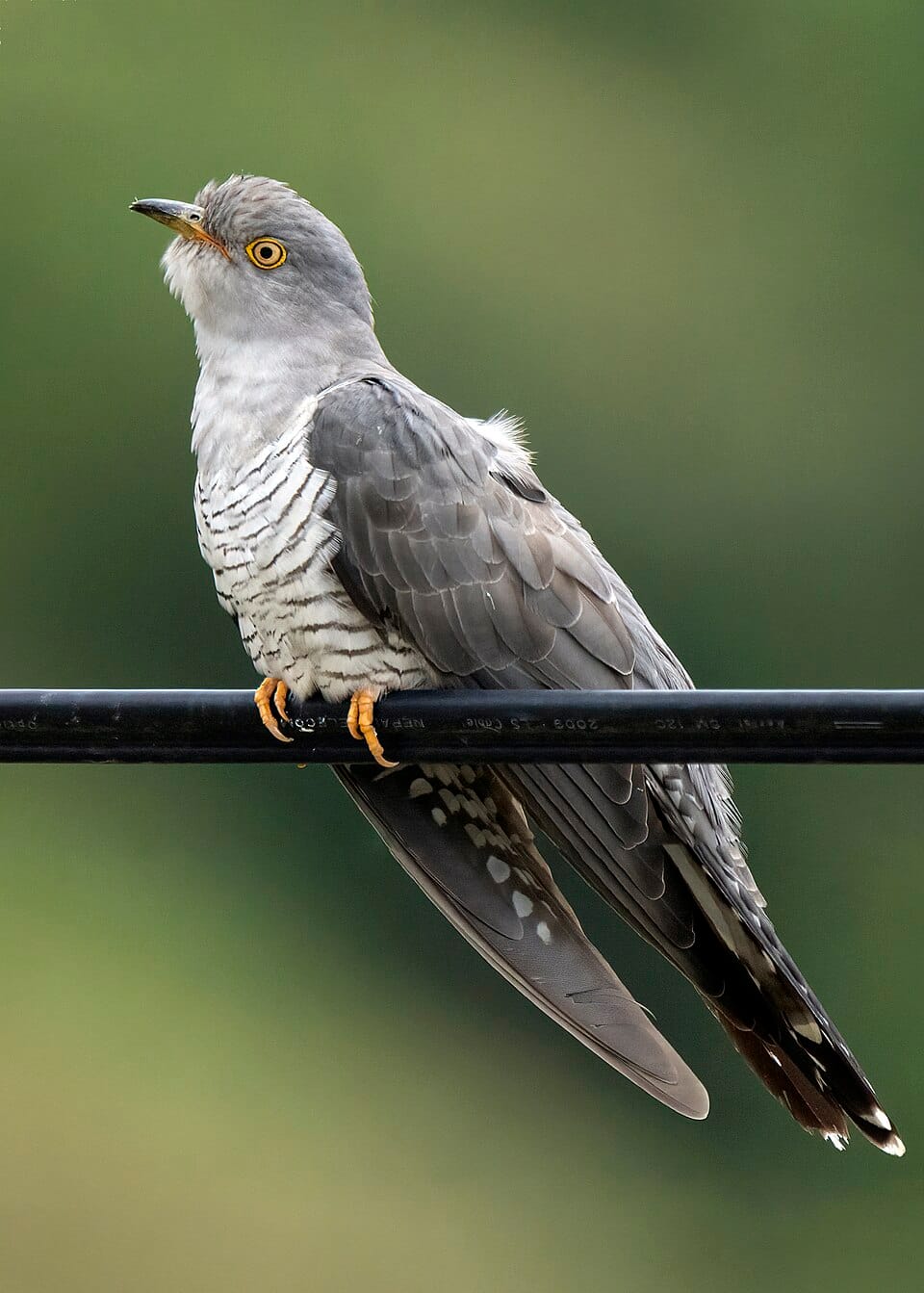
The common cuckoo, quite famously, does not build nests. The obvious follow-up question is, well, where do they raise their young? To which I am here to inform you that… they don’t. This is all likely confusing, since it strongly indicates a quickly ended species. Yet, the common cuckoo not only survives, but thrives, entirely on the work of other unaware, unlucky birds.
![[PRASAN SHRESTHA]](https://commons.wikimedia.org/wiki/File:Common_cuckoo_in_kathmandu_valley.jpg?ref=humbleoffering.com)
Cuckoos are, in a way, the deadbeat dads of the bird world. When they reproduce, they eschew all the annoyance of having to prepare a nest by simply sneaking their eggs into another bird’s nest. They slip their own beautiful bouncing baby bird amongst other eggs, opting another mother into an unknowing adoption process. They sneak each of their 12-22 eggs, one a piece, into other birds’ nests, and hope that their new prospective mothers are either unobservant or unbothered enough by an obviously different egg to accidentally raise their kids.
Of course, a one-hundred percent success rate is unlikely, and for the bird moms that do notice, it’s a pretty easy problem to take care of, given that eggs are both fragile and often exist at elevation, making elimination require not much more than a brisk, targeted nudge. No nudge? Congratulations on your new, entirely different looking brother or sister.
It was this behavior, known as brood parasitism, that inspired the French. Who better, as the purveyors of what is widely considered the most sexual language? Off of the word cocu, they would expand to a word describing a man-stepped-out-upon. That word, which would eventually make its way, since anglicized, to the Everything App? Was cucualt.
Not that any of this is likely to make seeing it directed at you or anyone you respect any less infuriating. At the very least though, now, every time you see it tossed around online, you can be at least momentarily blessed with the much less disgusting image of a neat, if very rude, bird.